Parliament’s Legal Affairs Committee says it plans to engage Director of Public Prosecutions (DPP) Fostino Maere to explain his office’s decisions to halt some criminal cases, mostly involving politically-connected personalities.
Section 99(2e and 3) of the Constitution empowers the DPP to discontinue any criminal proceedings at any stage before judgement and communicate reasons for the decision to the committee within 10 days for purposes of accountability.
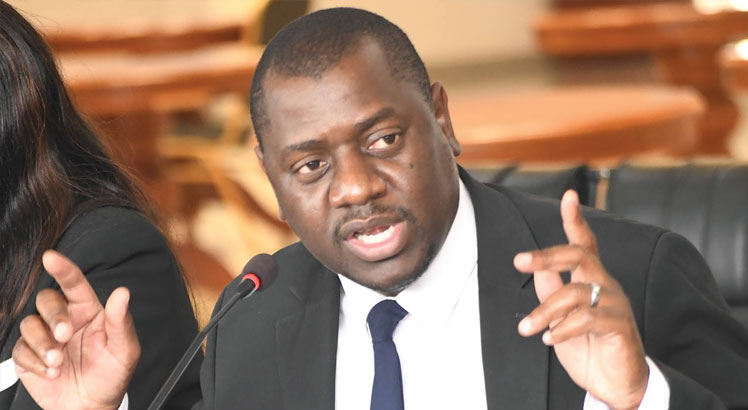
In a written response yesterday, Legal Affairs Committee chairperson Gilbert Khonyongwa acknowledged receipt of communication from the DPP explaining reasons behind the discontinuance of the cases in question.
He said: “The Legal Affairs Committee will, immediately upon the conclusion of the current Budget Meeting, convene to subject those reasons to rigorous scrutiny and to formally engage the Director of Public Prosecutions thereon.
“This engagement will be conducted in strict fulfilment of the committee’s constitutional oversight mandate, with a clear focus on ensuring transparency, accountability, and fidelity to the rule of law in the exercise of prosecutorial discretion.”
Khonyongwa, a private practice lawyer, said where necessary the committee would make appropriate recommendations arising from its deliberations.
The cases in question include Criminal Case Number 3 of 2023 in which Minister of Energy and Mining Jean Mathanga was cleared alongside three others as well as Criminal Case Number 2 of 2025 which let off the hook Minister of Finance, Economic Planning and Decentralisation Joseph Mwanamvekha and five others.
The DPP also discontinued Criminal Case Number 19 of 2023 involving current Reserve Bank of Malawi (RBM) Deputy Governor Henry Mathanga, former RBM governor Dalitso Kabambe and incumbent Secretary to the Treasury Cliff Chiunda.
Others are Criminal Case Number 3 of 2025 against Kabambe and Henry Mathanga, Criminal Case number 12 of 2024 involving Deputy Minister of Homeland Security Norman Chisale and another case against former Anti-Corruption Bureau (ACB) director general Reyneck Matemba.
Discontinuance of criminal proceedings involving high-profile individuals has in recent years drawn mixed reactions with commentators suggesting that politicians and their cronies were being shielded from justice.
Previously, former president Bakili Muluzi also had his case discontinued by the DPP.
In an earlier interview, University of Malawi (Unima) law professor Garton Kamchedzera said the pattern shows that political power has made a mockery of professional and technical judgement on part of certain members of the legal profession.
He said: “One hope is that the case may be brought back within the time specified in the order. The second hope is that a group or an organisation with sufficient interest can bring public interest litigation against the DPP.
“As they are currently drawn, the orders have a phrase that acknowledges that the court has limited powers, which is wrong as the DPP’s decision cannot override constitutional principles that are in Section 12.”
Private practice lawyer Shepher Mumba said more often, criminal cases are commenced for political reasons and without legal and or factual basis, prompting new DPPs to get rid of these political persecutions.
“However, this power is prone to abuse for personal gain or political expediency where cases are discontinued to serve political interests other than the cause for justice,” he said.
In Constitutional Case Number 1 of 2017, judges Maclean Kamwambe, Ivy Kamanga and Joseph Chigona ruled that the DPP executes Executive powers and not administrative powers, and that those powers, as a creature of the Constitution, are amenable to judicial review only in rare and extreme circumstances.
Section 77 (a) of the Criminal Procedure and Evidence Code states that after persons have been discharged, such discharge shall not operate as a bar to any subsequent proceedings commenced once within six months of the discharge, on account of the same facts.